Ministry Without a Messiah: The Quiet Rise of America's Humanist Chaplains
In a hospital waiting room outside Boston, a woman sits with a man she calls her chaplain. He does not quote scripture. He does not bow his head. He listens, asks questions, and helps her sort through the fear of her husband's diagnosis without once suggesting that a higher power has a plan. For thousands of Americans, this is what pastoral care looks like now — no prayers required.
The humanist chaplaincy movement is one of the most underreported developments in American religious life, precisely because it is not religious at all. It is a growing network of trained counselors serving students, patients, veterans, and service members who want the structure of spiritual care without the theology. And their struggle to be taken seriously says a great deal about how America defines — and polices — the boundaries of belief.
A Chaplain Who Believes in Nothing Supernatural
The movement's most visible institutional home is Harvard University, which in 2021 made national headlines when it formally recognized a chaplaincy organization led by an avowed atheist, Greg Epstein, author of Good Without God. Epstein's title — Humanist Chaplain — struck many commentators as a contradiction in terms. But on campus, the contradiction dissolves on contact with reality.
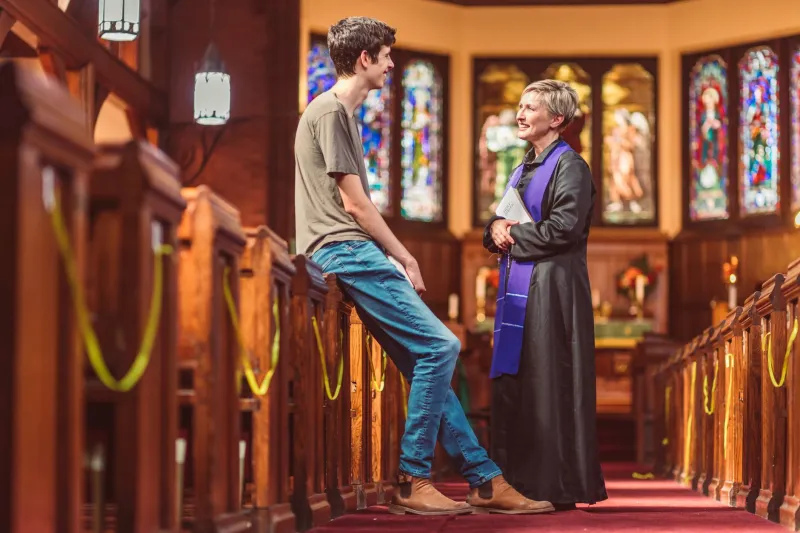
Chaplains, in practice, are not primarily theologians. They are presence-keepers. They sit with the dying, counsel the grieving, mentor the lonely, and help young people navigate the first real crises of their lives. Harvard's decision acknowledged what chaplains of every tradition have long known: the job is relational, not doctrinal.
Since Harvard's move, similar programs have taken root at Columbia, Stanford, Rutgers, and a scattering of public universities. The model is simple. A trained humanist chaplain — often holding the same master of divinity or counseling credentials as their religious counterparts — offers a secular alternative for students who find the campus ministry fair uninviting. The demand is larger than most administrators expected. Surveys consistently show that roughly a third of Americans under thirty identify as religiously unaffiliated, and the so-called 'nones' are not uniformly atheists; many are seekers, doubters, and the spiritually curious who simply cannot recite a creed.
The Pentagon's Long Reckoning
Nowhere has the fight for legitimacy been sharper than in the United States military. Chaplain corps are as old as the Continental Congress, which authorized chaplains in 1775. For most of that history, the chaplaincy has been an exclusively religious institution — Protestant, Catholic, and Jewish, with later additions for Muslims and other traditions. When nontheistic service members asked why the same counseling and moral support was unavailable to them, the answer for decades was effectively: it isn't.
That changed in fits and starts. Humanist and other nontheistic belief systems gained formal recognition from the Department of Defense for the purposes of religious accommodation — meaning a humanist soldier's conscientious objection or dress accommodation must be weighed like any believer's. In 2017, the Army quietly approved its first endorsed humanist chaplain candidate, though the broader chaplaincy remains overwhelmingly faith-based. Endorsing bodies for humanists, such as the Humanist Society, now exist to shepherd candidates through the same vetting process as their ordained counterparts.
The argument from secular advocates is straightforward and, to constitutional lawyers, familiar. If the government provides chaplains — and it does, paying salaries, building chapels, granting rank — then excluding citizens from that program because of their metaphysical views is a form of religious test. The First Amendment's guarantee of free exercise cuts both ways: it protects belief, and it protects the absence of belief. No citizen should have to pretend to faith to access a government benefit.
What Community Without Creed Looks Like
Skeptics of the movement ask a fair question: what does a humanist congregation actually do? The answer, in practice, resembles the answer for religious congregations, minus the liturgy.
Humanist chaplaincies run meal programs, organize grief groups, host speaker series, and hold weekly gatherings that look suspiciously like services — readings, music, a talk, coffee afterward. The difference is that the content is drawn from philosophy, literature, and shared ethical reflection rather than sacred text. At several campus programs, the Sunday assembly format has proven popular enough to outgrow its meeting rooms.
Critics within organized religion sometimes dismiss these efforts as derivative — atheism borrowing the scaffolding of the church it rejects. The criticism has some bite, and humanist chaplains largely concede it. Their response is pragmatic: humans evolved for community, ritual, and mutual care, and those needs do not vanish when belief does. A structure is not a doctrine. If the scaffolding works, use it.
Why It Matters for the Wall
For readers of this publication, the movement raises a question worth sitting with. The separation of church and state has historically been defended as protection from religion. The humanist chaplaincy fight reframes it as protection for conscience in all its forms — including the form that affirms no deity at all.
There are real tensions to watch. Public universities funding humanist chaplains must do so on the same terms as religious ones, or not at all. Military chaplaincy must expand its gatekeeping without becoming a platform for anti-religious advocacy. The goal is not to replace the pulpit but to end the requirement that one kneel to receive care.
The woman in the hospital waiting room was not converted to anything. She was accompanied. In a nation where the fastest-growing 'religious' group is the unaffiliated, that may be the most important ministry of all.