The Skeptic's Blind Spot: Why Rational Minds Fall for Irrational Traps
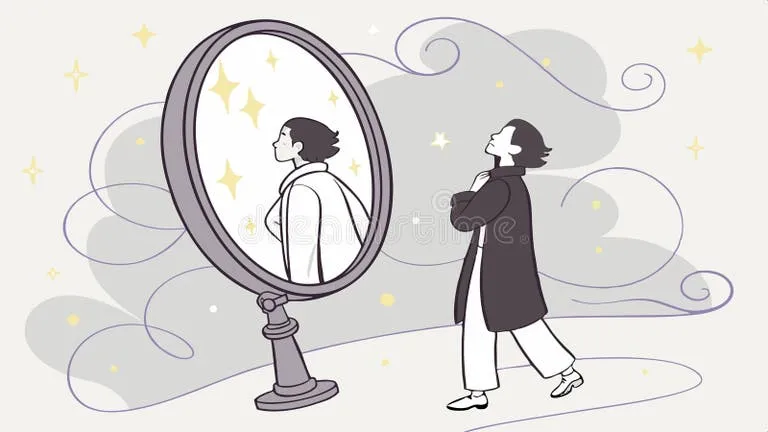
Photo: person thinking mirror reflection critical thinking concept, via thumbs.dreamstime.com
There is a particular irony familiar to anyone who has spent time in secular and skeptic communities: the person most confident in their own rationality is often the person least equipped to notice when it fails. Intelligence, it turns out, offers no immunity against flawed thinking. If anything, a sharp mind is better at constructing elaborate justifications for conclusions it reached for reasons it never examined.
At The Free Thought Association, we hold that liberty of the mind is the precondition for every other liberty. But liberty of the mind is not a trophy. It is a practice — closer to flossing than to a diploma. And like any practice, it requires an honest accounting of where we fail. Below are the mental traps most likely to catch a self-identified freethinker, drawn from decades of research in cognitive science, along with exercises designed to catch them in the act.
Confirmation Bias: The Collector of Agreeable Evidence
Confirmation bias is the tendency to seek out, remember, and privilege information that supports what we already believe. It is the most familiar bias on this list, which is precisely why it remains so dangerous. We all believe we've outgrown it.
Consider how Americans consume political news. A 2021 Pew Research study found that partisans on both sides are far more likely to trust news sources whose audiences skew their way — and to dismiss the same reporting when it appears in an outlet coded as adversarial. The freethinker who reads three newsletters, follows two podcasts, and scrolls one social feed has usually built a comfortable echo chamber and called it intellectual diversity.
The exercise: Once a month, write down a belief you hold strongly. Then spend thirty minutes genuinely searching for the strongest counterargument — not the strawman your side enjoys mocking, but the version written by the smartest person who disagrees. If you cannot state that opposing argument to the opponent's satisfaction, you do not yet understand the issue.
Motivated Reasoning: The Lawyer in Your Head
Where confirmation bias shapes what evidence you see, motivated reasoning shapes what you do with it. It is the difference between a scientist asking "what is true?" and a defense attorney asking "how can I get my client off?" When a cherished identity — political, religious, or antireligious — is implicated, we become advocates for our own prior conclusions.
Research by Dan Kahan at Yale demonstrated this vividly: people with greater numeracy and science literacy were actually more polarized on politically charged topics like climate change and gun control. Their skills did not guide them toward truth; they guided them toward more sophisticated defenses of their tribe's position.
The exercise: Before evaluating any claim, ask a simple question out loud: "What would I want to be true here?" Then ask whether your analysis would change if the claim came from the other side. If a statistic feels devastating when your opponent cites it and unremarkable when your ally does, motivated reasoning is doing the thinking for you.
The Dunning-Kruger Effect: Expertise in One Field, Confidence in All
The Dunning-Kruger effect describes how the least competent people tend to overestimate their ability — because the very skills needed to evaluate competence are the skills they lack. What receives less attention is that experts suffer a mirror-image problem: they sometimes assume their competence in one domain transfers to another.
The physicist who holds forth on constitutional law, the software engineer with unshakable theories about epidemiology, the philosopher certain she has settled monetary policy — these are fixtures of skeptical communities, not anomalies. Expertise is real, but it is specific. The scientist who is impeccably rigorous in the laboratory and careless on social media has not transcended bias; she has merely relocated it.
The exercise: Before offering a strong opinion outside your field, rate your knowledge on a scale from one to ten. Then try to name three leading experts on the topic and one serious argument against your position. If you cannot, treat your opinion as a hypothesis, not a conclusion.
The Sunk Cost Fallacy: Loyalty to Past Selves
We resist changing our minds partly because changing our minds means admitting we were wrong — and the longer we have held a position, the costlier that admission feels. This is the sunk cost fallacy applied to belief. Movements of every stripe, including secular ones, accumulate intellectual sunk costs: positions defended for so long that abandoning them feels like betraying the years invested.
The exercise: Periodically ask, "If I encountered this idea today, for the first time, with no history attached — would I find it persuasive?" Separate the idea from your investment in it.
The Availability Cascade: Mistaking Loudness for Prevalence
What we see most often, we believe to be most common. Social media has weaponized this tendency: a vivid, outrageous anecdote can distort a nation's sense of reality faster than any statistic can correct it. Americans consistently overestimate rates of crime, immigration, and rare dramatic events — not because they are foolish, but because their information environments are calibrated for engagement, not accuracy.
The exercise: When a claim feels urgent and obvious, ask for the base rate. Then ask how you encountered the claim — through data, or through a story designed to be shared?
A Discipline, Not a Destination
None of this is grounds for despair. The point of cataloging our cognitive weaknesses is not that reason fails, but that reason can be applied to its own failures. That recursive move — using critical thinking to audit critical thinking — is the entire project of free thought.
The freethinker's creed, if we may be permitted one, is not "I have no biases." It is "I have built habits that catch my biases before they harden into dogma." Dogma, after all, is not a religious phenomenon. It is a human one. And the antidote is not a certificate of rationality, but the daily, unglamorous work of doubt — beginning, always, with ourselves.